Desalination of Process Water and Boiler Feedwater
High-quality process water and boiler feedwater are essential for thermal processes in industry. Targeted water desalination protects equipment…
Our areas of application
The companies in the HydroGroup® develops high-quality processes, plants and systems for water treatment and water supply. Our comprehensive process engineering expertise…
Water needs technology - we supply it
Directly to the application areas
Municipal water suppliers ensure that households and industries are reliably supplied with clean drinking water every day.…
Ion Exchange for Process and Boiler Feed Water in Industry
Ion exchange is a proven method for the targeted removal of dissolved ions from water. It is used whenever water needs to be softened,…
Oxygen for Water Treatment
Oxygen is the most important oxidizing agent in water treatment. It plays a central role in the oxidation of iron, manganese, and other reduced substances in water.…
Trace substances are chemical compounds that can be detected in water at very low concentrations (in the micro- or nanogram range). Even though they occur only in trace amounts, some of these…
The purpose of water sanitization and disinfection is to reliably and permanently reduce or eliminate pathogens and microbial contamination. The goal is to provide hygienically safe and…
Nanofiltration (NF) and reverse osmosis (RO) are the main processes used to separate dissolved substances such as salts from water. They differ in particular in terms of their separation accuracy,…
Hydroxy type oxygen generators
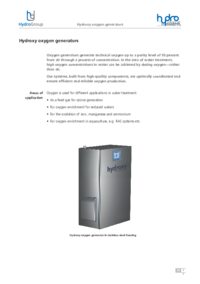
Hydroxy oxygen generators Hydroxy oxygen generators Oxygen generators generate technical oxygen up to a purity level of 95 percent from air through a process of…
Working for the HydroGroup®
A contemporary work environment, motivated staff, cutting-edge technology and an innovative mindset enable us to offer problem-driven, customer-specific technologies,…


![[Translate to English:]](/fileadmin/user_upload/stellenangebote-grafik-target.svg "[Translate to English:]")