


Nanofiltration (NF) and reverse osmosis (RO) are the main processes used to separate dissolved substances such as salts from water. They differ in particular in terms of their separation accuracy, the operating pressure required and their respective areas of application.
Nanofiltration and reverse osmosis are used in particular for water softening, seawater desalination, and the treatment of process water and ultrapure water.
Gases such as CO2 pass through the membranes, which is why appropriate post-treatment is often necessary.
To prevent the buildup of scale on the membranes, special chemicals (known as antiscalants) must be added in measured doses. The choice of antiscalants must be tailored to the specific water composition.
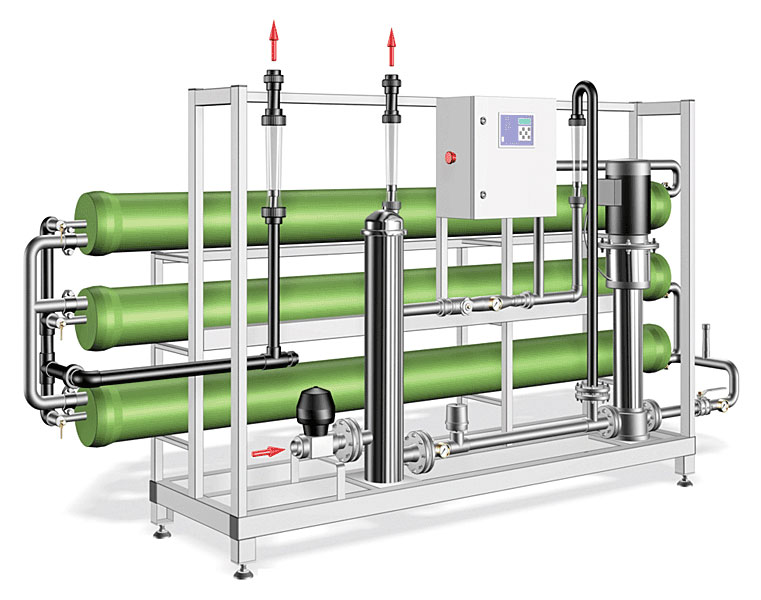
Nanofiltration
Nanofiltration operates at comparatively low pressures between 6 and 8 bar. NF membranes primarily retain polyvalent ions, such as calcium, magnesium, sulfate, iron, manganese, or larger organic molecules. Monovalent salts, such as sodium chloride, partially pass through the membrane.
For this reason, nanofiltration is particularly suitable for water softening, partial desalination, and the removal of humic substances (discoloration), pesticides, PFAS, or organic micropollutants.
Reverse osmosis
Reverse osmosis achieves nearly complete desalination. In this process, water is forced under pressure through a semipermeable membrane. The required pressure is largely determined by the salinity of the raw water, the type of membrane, and the temperature.
For the desalination of drinking water, typical operating pressures are 10–12 bar; for seawater desalination, pressures of up to 60 bar or more are required. Dissolved salts, nitrate, arsenic, heavy metals, PFAS, organic trace substances, and many other constituents are retained to a very large extent.
Application of the procedures
In the context of drinking water treatment, nanofiltration and low-pressure reverse osmosis (LPRO) are primarily used for central water softening and decolorization. This process removes, in particular, the hardness-causing elements calcium and magnesium, as well as larger molecules such as DOC and trace substances like PFAS.
During softening, the desired target hardness is achieved through bypass controls. The carbon dioxide in equilibrium remains in the water and must be removed via degassing processes after nanofiltration (see deacidification).
In process water treatment, complete desalination via reverse osmosis is often required. In subsequent steps, fine purification usually takes place, for example, via an EDI system.
With increasing demands on water quality, resource conservation, and recycling, reverse osmosis is becoming increasingly important. Especially in regions with limited water resources, it enables a reliable and sustainable supply of high-quality process water.
In seawater desalination for drinking water production, sodium chloride must primarily be removed. Due to the high pressures required and large flow rates, energy recovery systems are used here. The fully desalinated water requires post-treatment for remineralization, pH adjustment, and final sanitization.
Send us your requirements and we would be very happy to help you.