


Why Disinfection Is Important
Water can become microbiologically contaminated on its journey from the source to the consumer.
Possible sources of contamination include:
- infiltrating surface water
- biofilms
- damaged pipe networks
- contamination in storage tanks
- organic matter
- temperature increases and stagnation
Without adequate hygiene measures, microorganisms can multiply and compromise water quality.
In accordance with relevant regulations, drinking water must always and consistently be of perfect quality in terms of hygiene. To ensure this, the following disinfection measures are implemented as part of the water supply system, depending on specific requirements.
Disinfection procedure
Chemical Disinfection with Chlorine
Chemical disinfection typically involves the metered addition of chlorine-containing agents (chlorine dioxide, sodium and calcium hypochlorite solutions, or chlorine gas). Chlorination is used either as a continuous addition for network protection or temporarily in the event of damage. Chlorine can provide long-term protection in the distribution network. A disadvantage is the impairment of taste and the possible formation of byproducts. For this reason, chlorination is usually used at the end of the operating cycle.
Chemical disinfection with ozone
The use of ozone achieves excellent disinfection. Ozonation is typically implemented as the first step in a treatment chain followed by a filtration stage. This stage serves to break down residual ozone and facilitate biological mineralization. Ozone is not suitable for network protection.
Membrane filtration
Membranes (pore size less than 0.2 µm) can retain microorganisms and remove them from the water. In certain cases, microorganisms can pass through the membranes. For safety reasons, UV systems are therefore installed downstream of the ultrafiltration systems.
UV Disinfection
The disinfection of water with UV light is a physical process. Under favorable conditions, UV-C radiation inactivates microorganisms in the water by destroying their DNA, preventing them from reproducing and causing them to die. Since this is a physical process, UV treatment does not produce any chemical or health-hazardous byproducts. Ultrasound can also be used to enhance the effect.
Thermal Disinfection
Thermal disinfection is primarily used for boiling water in households or in hot water systems for Legionella prevention.
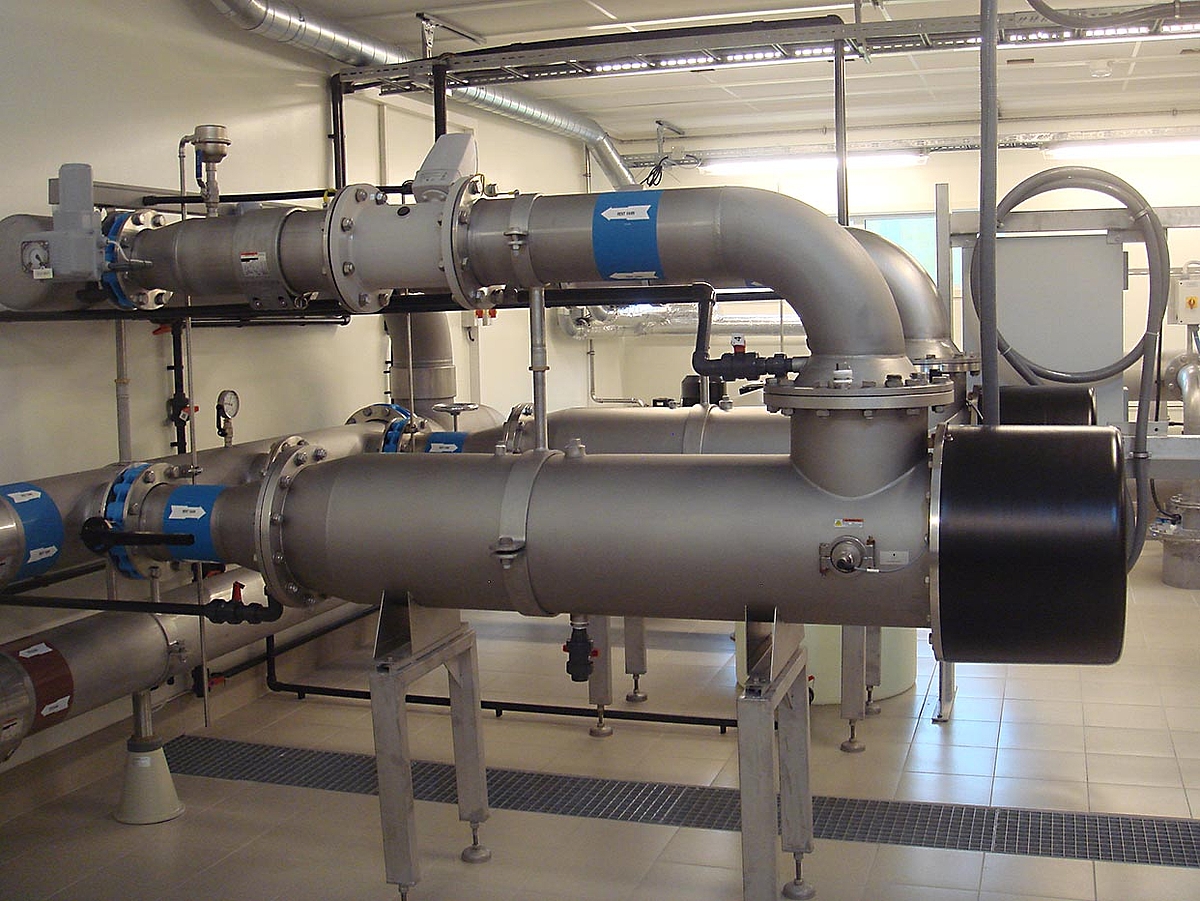
Exampel UV treatment for drinking water treatment
A requirement for UV treatment is water free of turbidity and a low microbial load. UV treatment is only effective during the radiation time, i.e. does not have an enduring effect in the net. UV systems are often used as the last stage in a treatment chain for final hygiene processing. Only tested and certified systems with a minimum dose of 400 J/m² may be used. If several systems are operated in parallel, the flow rate must be measured and, if necessary, controlled.