


Deacidification and Hardening
Drinking water must be corrosion-neutral in accordance with applicable regulations. The Drinking Water Ordinance specifies a pH range between 6.5 (slightly acidic) and 9.5 (slightly alkaline).
Natural groundwater and spring water often contain excess carbon dioxide (CO₂) and are therefore considered acidic. CO₂ concentrations of up to 100 mg/L are not uncommon. Before such water is fed into the supply network, the chemical balance must be adjusted. Depending on water hardness and pH, different treatment processes are used for deacidification or hardening. Hardening, in particular, mineralises and stabilises very soft (low-mineral) water.
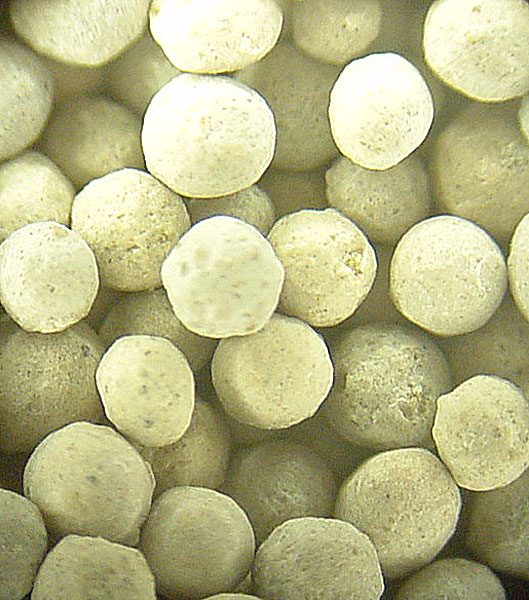
Chemical deacidification
Filtration through calcium carbonate–containing materials such as semi-calcined dolomite, marble, or Jura limestone neutralises free, aggressive carbonic acid until the calcium carbonate–carbonic acid equilibrium is reached. The free carbonic acid reacts with the calcium carbonate in the filter material and gradually dissolves it. For this reason, deacidification filters must be replenished regularly.
Small amounts of iron can also be removed in the process. At higher iron concentrations, pre-filtration is necessary, as iron deposits on the deacidification material impair its effectiveness.
Chemical deacidification is mainly used in small plants, particularly where deacidification demand is low and the water has low hardness.
Physical deacidification
Physical deacidification is an efficient method for treating water with sufficient carbonate hardness. In this process, excessive, aggressive carbon dioxide (CO2) is "stripped" (desorbed) from the water through contact with air until the calcite-carbonic acid equilibrium is reached. This is achieved by maximizing the water's surface area and ensuring high air-to-water ratios. The primary driving force for this gas exchange is the difference in partial pressures between the liquid and gas phases.
Common technical implementations include:
- Spraying: Fine distribution of water into the air via specialized nozzle systems.
- Trickle Columns (Packed Towers): Water trickles down over packing material while air is fed upwards in a counterflow.
- Flatbed Aerators: Air is forced through a layer of water, creating fine bubbles and intense turbulence.
Additional Benefits: Beyond deacidification, physical stripping effectively removes other dissolved gases and volatile compounds, such as:
- Hydrogen sulfide (H2S)
- Methane (CH4)
- Radon
Physical deacidification is also a standard post-treatment step in membrane softening processes (e.g., reverse osmosis or nanofiltration) to stabilize the water and restore the calcium-carbonic acid balance shifted during filtration.
Subdimensionalised limestone filtration
In many cases, a combination of physical and chemical deacidification is also possible. This enables ideal degrees of hardness to be set. The raw water is first hardened to the desired degree (chemical deacidification), and the remaining deacidification takes place physically.
Consulting and Planning
Are you interested? We would be pleased to support you in the design of your water treatment system and in selecting the optimal process. Please contact us.